


Komerz OS
From a research question to a business plan you can sign.
An AI commercial-planning platform for consumer brands. A research agent answers where to play, then a planning workspace builds how to win, down to a P&L that reconciles.
- Product
- Komerz OS
- Domain
- Commerce and Finance
- Category
- AI platform · Commercial planning
- Platforms
- Web workspace, Research agent, Serverless platform
- Services
- Technology consulting, AI agent engineering, Product design, Platform engineering
- Practices
- AI Agentic Systems and Data, Application Development, Technology Consulting
- Year
- 2026
Challenge
Komerz helps consumer brands decide where to play and how to win: which markets, channels, prices and packs, and what the P&L looks like if they get it right. The method lived in consultants' heads and spreadsheets. Komerz wanted it as software: a research partner that answers commercial questions, then turns the answer into a plan a brand can take to a buyer or a board.
Approach
Komerz OS is two workspaces joined by one bridge. Where to Play is a research chat that reads the brand's own files, Komerz's proprietary market data and the public web, and answers with citations, reports, decks and workbooks. How to Win turns that research into channels, competitor pricing, price and pack, value chains, volume plans and a monthly P&L.
We rebuilt the platform from the ground up on a serverless AWS stack, with an agent that orchestrates specialist models and a set of deterministic engines that own anything a finance team has to trust. Convert to project carries the whole conversation, its files and its template choices into the plan, so nothing gets typed twice.
03Insight
Let the model make the judgment calls. Never let it do the maths.
Language models are brilliant at reading a market and terrible at being a calculator: a confident wrong number looks exactly like a right one. So we drew a hard line through the system. Models decide what matters and which template fits; compilers, evaluators and budgets decide what gets computed, what runs and when to stop. Every hard problem in the project came back to where that line sits.
04Hard problem 01 of 02
Make an AI build a P&L without inventing a single number.
How do you let a model draft a three-year business plan when one plausible wrong margin can sink the deal it was built for?
A brand takes this plan to a retailer, an investor or its own board. Text can be a little wrong and still be useful. A P&L can't. Every figure has to trace back to a price, a margin, a cost or a stated assumption, and the workbook has to keep computing when someone changes a number at 11pm before the meeting.
Why it’s hard
- Models write formulas like poetsAsk a model for a spreadsheet and it invents costs, breaks cell references and builds circular logic, all formatted beautifully.
- Every channel has its own waterfallThe path from shelf price to manufacturer cost changes with the market and the route: tax, retailer margin, distributor margin, platform fees, promotions.
- Unknown is not zeroA missing cost silently treated as zero turns into invented profit. The system has to carry not-knowing all the way to the bottom line.
Through the loop
Frame
The risk isn't a bad sentence. It's a believable number. We traced how a Komerz consultant actually builds a plan, from the shelf price down to what the manufacturer keeps, and marked every point where an AI could make a number up. That reframed the brief: the job wasn't to make the model better at spreadsheets, it was to take the arithmetic away from it entirely.
Design
Split judgment from arithmetic. We designed a control model with two owners. The model chooses: which products, which routes, which template fits and which scenario inputs to try, each with a stated reason and confidence. A compiler owns every formula. Edits follow the same split: you say what to change, the engine decides what that does to the plan.
Engineer
A compiler for commercial logic. Komerz's templates are written as row references, like R1 × R4. The compiler translates them into live Excel formulas, works out each row's role in the P&L from the waterfall, and refuses to build if net sales minus variable spend doesn't reconcile to manufacturer cost. The same formula engine runs in the agent and the API, held identical by a parity test, so a number in chat matches the number in the workspace and the download.
Prove
Audit every template, then reconcile to the last decimal. When one production run hit a circular reference, we didn't patch that template. We audited all of them. Three formula defects came out, including a value chain that ran backwards. Every template now compiles a full 8-sheet, three-year forecast as a test. Then we ran a live brand plan end to end and reconciled it against the source data.
Operate
Fast first, then right, then both. Research workbooks got the same treatment in production. One planning call designs typed columns, tabs are written in parallel, every row is mapped to its source, and the file is published first and verified after. Only the tabs that fail get repaired; passing tabs are kept byte for byte. Edits are routed by where a workbook came from, so a compiled plan never gets rewritten by a generic writer.
Back to Frame
The model makes the calls. The compiler does the maths.
- Unallocated balance on a live plan
- 0.00
- Formulas, zero errors
- 2,704
- Templates audited and compiled
- 9/9
- Time to first workbook
- −66%
08Hard problem 02 of 02
Let an agent think for twenty minutes on compute that quits at fifteen.
How do you run deep, multi-step research in a multi-tenant product, where every turn is bounded, survives a crash and pays for each search exactly once?
A real commercial question takes real work: read the attachments, search proprietary data, search the web, find the gaps, search again, then build a deck or a workbook and check it. That can take longer than a serverless function is allowed to live. And every repeated search or model call is money the client pays twice.
Why it’s hard
- A hard deadlineA Lambda function stops at fifteen minutes and an HTTP request gives up long before that. The work doesn't care.
- Retries cost moneyPlatforms retry failed work. Without care, a retry re-runs paid searches and model calls, or two workers answer the same prompt.
- Freedom versus safetyA rigid classifier can't handle real conversations. An agent with free rein can't be trusted with many companies' private data.
Through the loop
Frame
The first version asked permission for everything. The original flow sent every message through a classifier with three buckets, then a keyword allowlist. It was predictable and it broke on the second follow-up. Watching real conversations showed what users wanted: an analyst who decides for itself when to search, when to stop and when to build something.
Design
Bounded agency. Our rule: the model decides whether a capability is needed; guarded tools decide how it runs. The agent gets about a dozen tools, such as inspect an attachment, search proprietary data, search public sources, check coverage, create an artifact. It gets no shell, no raw filesystem and no code execution. It works inside budgets it can see, and it can only create or change a file when the user's words grant it.
Engineer
Work that outlives the machine running it. The API accepts a prompt and returns immediately. The agent runs on its own and streams planning, thinking, task and answer events back over a real-time subscription. An idempotent lease ensures one prompt has one owner. Fingerprinted checkpoints on a per-chat file system keep every finished search and plan, so a worker that takes over picks up the evidence instead of paying for it again. Decks, workbooks and project builds run on their own workers and step functions, with dead-letter queues behind them.
Prove
Break it on purpose, and write down what broke. The first agentic build did worse than the old one: five of six runs crashed. We said so in writing, ran three independent review rounds and fixed what they reproduced. Every change since ships with a dated report: root cause from traces, the fix, the tests, and the same prompt run live against production for comparison. Transport tests fast-forward time to prove 18- and 50-minute turns still land.
Operate
Every bill itemised. Every change reversible. In production, each model call records its tokens, cached tokens, reasoning tokens and why it stopped, priced from a versioned catalogue across four providers and rolled up per prompt, user and month, with limits admins can set. Every major change ships behind a flag, from shadow to canary to default, with the previous path kept as an instant rollback. When a deck once took eighteen minutes, the trace showed a parser timeout being read as broken code; after the fix, the next live deck needed zero repairs.
Back to Frame
The model decides what to do. The system decides how far it may go, and remembers where it stopped.
- Longest turn proven in tests
- 50 min
- Each paid search, even on retry
- 1×
- Automated tests
- 1,874
- Agent eval scenarios
- 18
All case studies
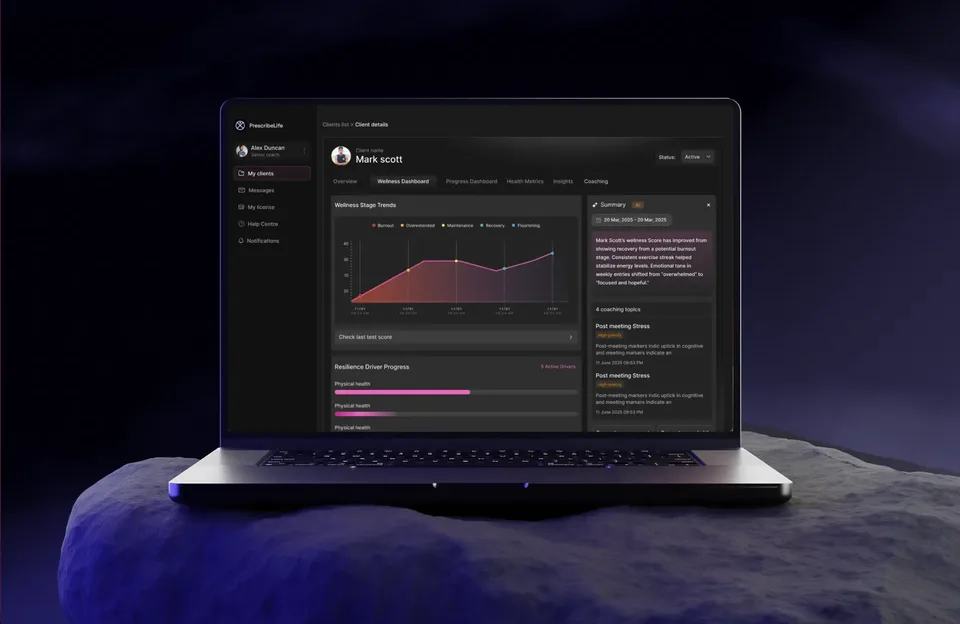
AI platform · Web + mobile
Prescribe Life
An AI performance-intelligence platform for leadership coaches. Behavioural science, biometric data and an AI co-pilot flag burnout risk between sessions.
Read Prescribe Life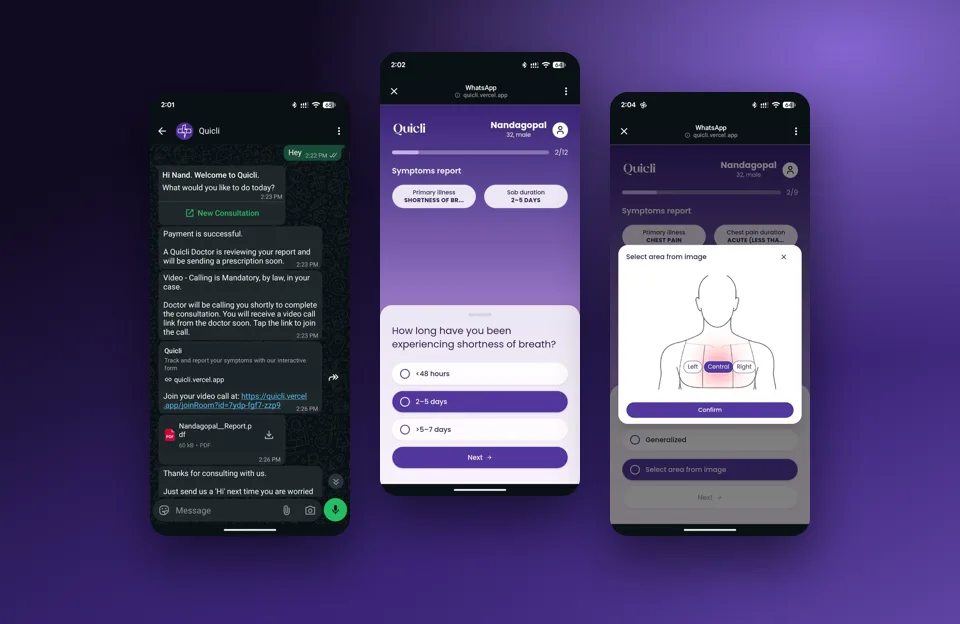
Health platform · WhatsApp + web + doctor app
Quicli
Doctor consultations on WhatsApp. Say 'Hi', describe your symptoms in your own language, and a real doctor's prescription arrives in the same chat, with medicines and tests ready to order.
Read Quicli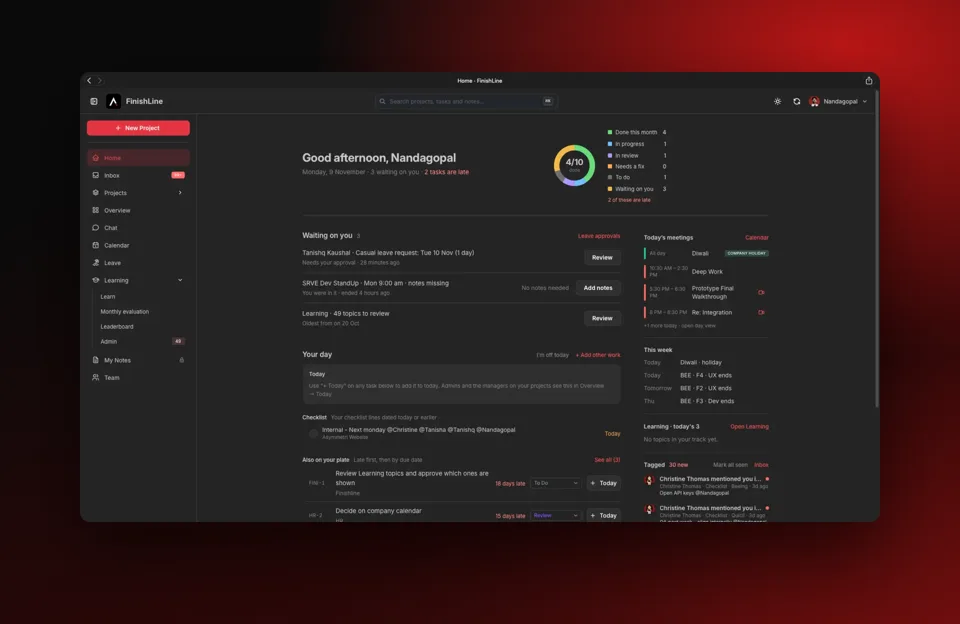
Internal platform · Web app + AI agents
FinishLine
Asymmetri's own delivery operating system: projects, QA, clients, chat and calendars in one secure app, where AI agents work as the person who sent them.
Read FinishLine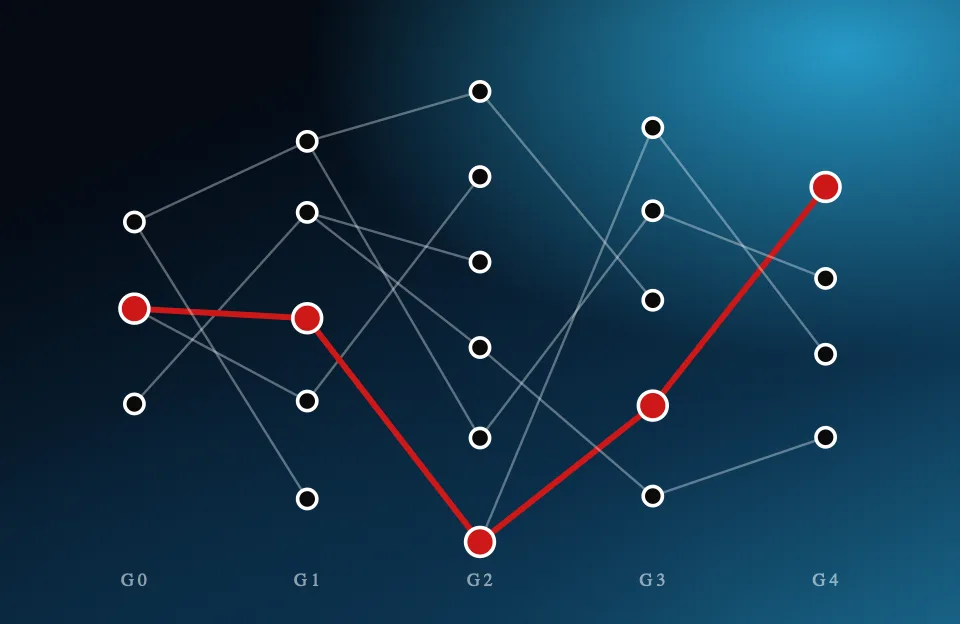
Research · Multi-agent AI
Project Protocol
Asymmetri research into shared machine cognition: can teams of AI agents write what they learn into a shared, inspectable layer that the next agents inherit and build on?
Read Project Protocol